Learning Framework
Discover how AME moves from learning foundations to daily practice — from neuroscience-aligned conditions for learning to a Curiosity-to-Contribution journey and the rhythm of an intentional AME school day.
The Always Meaningful Education (AME) Approach is a neuroscience-aligned, curiosity-driven model that helps learners understand how they learn, why it matters, and how to contribute meaningfully through curiosity, creation, and purpose.
For example, a learner curious about oceans might research marine ecosystems, create a project, and share their findings with the community.
The Roots
Learning Grows From the Inside Out
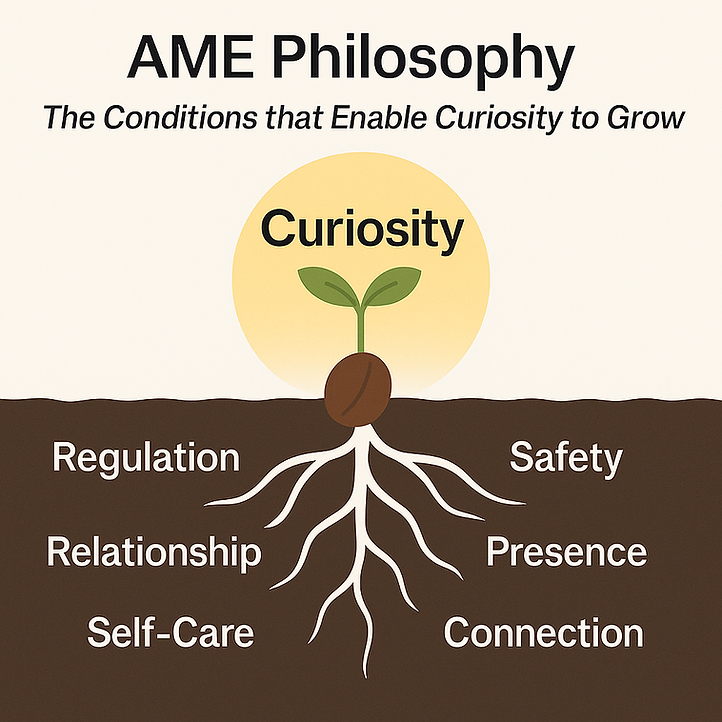
In AME, meaningful learning begins with roots — the biological and relational foundations that make curiosity, attention, and growth possible. Before a learner can explore ideas, they must feel safe, connected, regulated, and aware of themselves.
The AME roots include:
Self-Care & Daily Practices
These roots prepare the brain and body for inquiry, creativity, thinking, and meaningful contribution.
AME moves education from compliance to consciousness. Instead of focusing on what to teach and when, it centers on why learning matters and how students grow through it.
Learning begins with curiosity and relevance — not age or grade level. Students don’t just absorb information; they learn how to learn through neuroscience-based strategies that strengthen memory, flexibility, and real-world application.
This is learning as a lifelong process of becoming — building knowledge, awareness, adaptability, and identity.
Who Learners Become
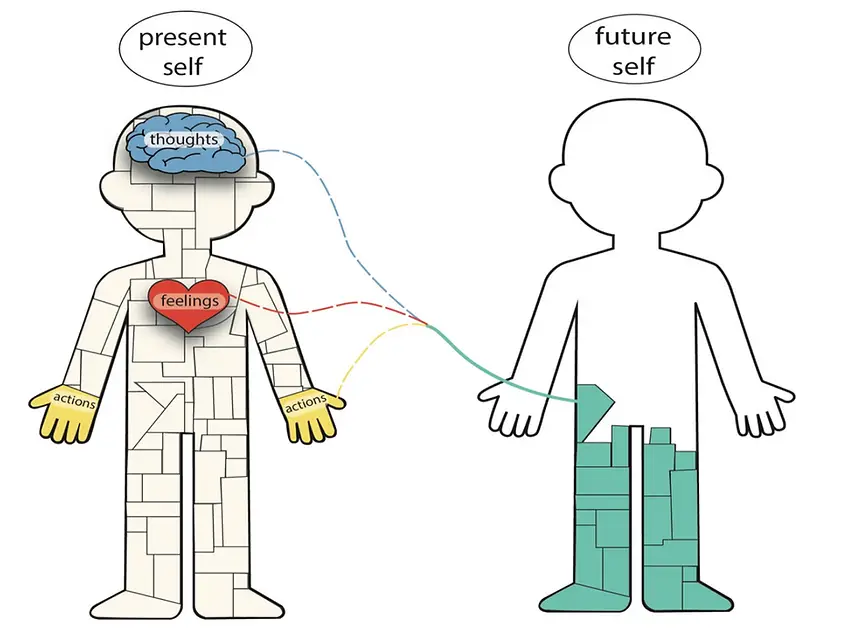
Growing From the Present Self Toward the Future Self
AME helps learners understand who they are now — and who they can become. Students develop the ability to regulate their attention and emotions, to reflect on their strengths, and to make intentional choices aligned with their future selves.
This journey strengthens self-awareness, purpose, emotional intelligence, and inner capability.
The 3Cs
Learning at AME follows a simple but powerful journey — from curiosity to creation to meaningful contribution.

Questions spark learning. Students explore ideas through neuroscience-informed approaches, developing understanding through both input and application.
Learners turn ideas into tangible work — designing, building, writing, and creating projects that demonstrate understanding.
Learning is shared beyond the classroom, creating real-world impact through collaboration, creativity, and purpose.
Each day is intentionally designed to support regulation, curiosity, and meaningful work.

The day begins by creating safety and connection through grounding practices, helping students feel calm, present, and ready to learn.

Students explore questions, ideas, and themes that spark interest and invite inquiry.

Learners engage in focused work—building, writing, designing, and collaborating to bring their ideas to life.

Students share their work, reflect on their learning, and connect their experiences to a broader purpose.
Testimonials
What Parents Say
Learning at AME follows a simple but powerful journey — from curiosity to creation to meaningful contribution.

In AME, students explore their curiosity through multiple academic and real-world perspectives:science, math, literacy, geography, history, art, identity, and purpose.
This interdisciplinary approach deepens understanding and strengthens flexible thinking.
Combined with the 3Ms — Mindset, Motivation, and Methods — this phase teaches learners the most important skill of all: how to learn.
THE AME FRAMEWORK
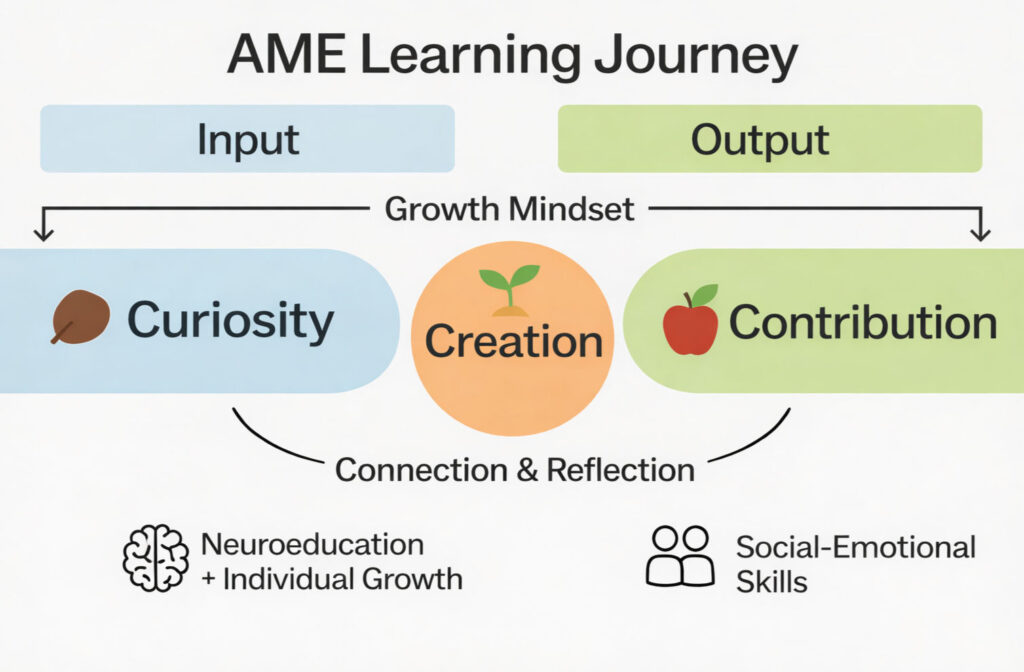
In the AME learning model students grow themselves in both content and life skills as they discover a new topic born from their curiosity. Once they have dedicated time to inputting new skills and knowledge, they decide how to use the output phase of the learning journey to apply what they learned towards amelioration. Its always meaningful education.
Students learn:
Through experimentation, students discover how they learn best by exploring:
Students engage with research in neuroscience and well-being to understand how thoughts, emotions, and physical health shape learning.
This is reinforced through practices such as:
By combining science with lived experience, students build self-awareness and learn how to optimize their growth.
In the Output Phase, students apply learning in real-world contexts — turning knowledge into action.
They develop:
Community impact – creating solutions that benefit others.
AME at Home
Join the Google Classroom “Meaningful Learning” and understand how I execute the model so you can too. Reach out to us to discover the many ways we support the implementation and execution of the AME model.
AME at Home
Want to use AME in your homeschool, micro-school, or hybrid program? Contact us to learn about the various levels of support we offer to help everyone access the AME model and reach their full potential.
AME Consulting
Alexandra supports families in transitioning to the AME model. She works with local schools to help families use hybrid models where students attend a traditional school and homeschool. She oversees homeschool and micro-school programs and provides training.
Who Learners Become
For micro-schools, homeschools, and innovative schools who want a full-day model grounded in the AME framework.
At Always Meaningful Education, each school day is intentionally designed to regulate the body, activate curiosity, strengthen executive functions, build skills, and guide learners toward meaningful creation and contribution.
We currently serve learners ages 4–15 (so far), though AME is not age-limited. The AME Approach adapts to different developmental stages and supports mixed-age, interest-driven learning across all levels.
01
Morning Self-Care & Regulation
Every AME day begins with somatic and neuroscience-aligned practices that regulate the nervous system and prepare the whole learner for engagement:
These practices create the brain–body state required for curiosity, focus, emotional resilience, and learning.
02
Morning Meeting (Executive Function & Intentionality)
After regulation, we gather for our morning meeting. Here, learners:
We often ask questions like:
This intentional routine is grounded in neuroscience: when learners set clear goals in a regulated state, their attention, motivation, and memory are significantly strengthened.
03
Independent Learning Blocks (Personalized Skill Development)
Independent learning time supports both academic growth and each learner’s broader AME Learning Journey. During these blocks, students engage in:
In AME, readiness drives learning, not grade level. A younger learner might be building a museum exhibit or storybook; an older learner might be writing a book, filming a documentary, or designing a project with real-world impact.
04
Progress Meeting (Reflecting on Brain Growth & Strategies)
The key reflective questions here are:
This builds metacognition, self-awareness, and ownership over learning. Students are not just doing tasks; they are learning how they learn.
05
Collaborative Creation & Contribution Work
After the Progress Meeting, students move into a collaborative block. Here, they:
This block can focus on: Internal Outputs (within our immediate AME community)
and/or
Real-World Contribution Work (beyond our immediate AME community)
This is where learners begin or continue the outward-facing contribution phase of their AME Learning Journey, applying their learning in wider contexts, such as:
Developing environmental or community service projects
In this block, students are either:
06
Reflection & Closing Ritual
We end each day with a reflection and closing ritual. This may include:
This closing process helps consolidate learning, supports healthy closure, and prepares the mind and body for rest and the next day.
07
Mixed-Age Learning (Ages 4–15 So Far)
AME intentionally brings learners of different ages together. Mixed-age learning:
Our current learners range from 4 to 15 years old (so far), and the approach scales naturally beyond that range.
Weekly Highlights: Class Dojo Reports
This section showcases weekly snapshots of learning in action:
Self-care practices, morning meetings, independent learning, progress meetings, collaborative creation, and community contribution.
Below you can find summaries of some of the AME Learning Journeys that have taken place around the world. These examples highlight how curiosity-driven, interdisciplinary learning unfolds in real environments, showing how students explore meaningful questions, collaborate, and share their discoveries with their communities.
Stoicism Web App Development
Program Type: Micro School
Location: Philippines
Ages: 11–15
Date: September 2025
Field Notes:
This micro-school cohort spent the fall diving into Stoic philosophy, personal agency, and the neuroscience of emotional regulation. Their curiosity led them to design and build a Stoicism web app for teens, inspired by their own need for accessible emotional tools at school and at home.
Hybrid Sibling Learning Journey
Program Type: Hybrid School / Home Integration
Location: Medellín, Colombia
Ages: 7–9
Date: July 2025
Field Notes:
Two siblings working across a hybrid model explored learning through multiple daily AME phases: morning self-care, inquiry, independent skill building, and collaborative creation. Their learning journey included advanced math challenges, science explorations, Spanish-English literacy integration, and social-emotional growth.
Future News Network
Program Type: Hybrid School
Location: Spain
Ages: 9–12
Date: August 2024
Field Notes:
During a hybrid homeschool cycle in Spain, students launched the Future News Network, a student-run broadcast channel. Their interest in space, Peru’s canyons, meteor showers, and current science events shaped the content.
Inspired Artists & Cabarete Art Museum
Program Type: Hybrid School
Location: Spain
Ages: 9–12
DateProgram Type: Hybrid School
Location: Spain
Ages: 9–12
Date: August 2024
Field Notes:
During a hybrid homeschool cycle in Spain, students launched the Future News Network, a student-run broadcast channel. Their interest in space, Peru’s canyons, meteor showers, and current science events shaped the content.
Cabarete Coconut Christmas
Program Type: AME Full School Program
Location: Cabarete, Dominican Republic
Ages: 6–12
Date: December 2022
Field Notes:
Students explored the coconut tree as a system—biology, ecology, cultural uses, sustainability, and entrepreneurship. They made baskets from palm fronds, extracted and processed their own coconut oil, decorated jars, and sold the products during a community holiday event.
Physics Fair
Program Type: Homeschool Cohort
Location: Boracay, Philippines
Ages: 6–10
Date: July 2022
Field Notes:
This homeschool group engaged in an ambitious deep-dive into physics—motion, force, electricity, optics, magnetism, sound waves, thermodynamics, and even introductory quantum physics.
SMB Kids Academy: Book, Rap Video & YouTube Channel
Program Type: International Cohort
Location: Turks & Caicos
Ages: 6–13
Date: January–April 2021
Field Notes:
At SMB Kids Academy, students embarked on a rich, interdisciplinary learning journey that combined storytelling, creativity, and collaborative exploration. Throughout the project, learners worked together to research, write, and publish their own book titled “A Journey of Discovery Through Big Blue.”
The book reflects the students’ curiosity, imagination, and growing confidence as creators and storytellers. Their work culminated in the publication of the book, allowing their ideas to reach a broader audience beyond the classroom.
You can view and purchase the book here:
A Journey of Discovery Through Big Blue
https://a.co/d/05HEDNq2
COVID-19: To Fear or Not to Fear?
Program Type: Singapore International Micro School
Location: Singapore
Ages: 5–9
Date: Spring 2020
Field Notes:
During the COVID-19 learning journey, students explored the science behind global health challenges by studying biology and microbiology, including how bacteria and viruses develop, spread, and impact human health.
As their understanding grew, students synthesized their research and insights into presentations designed to educate others. The project culminated in students preparing and delivering TED-style talks at a junior TED event in Singapore, where they shared their findings and reflections with a wider audience.
Through this experience, learners practiced scientific inquiry, communication, and real-world application of their knowledge.